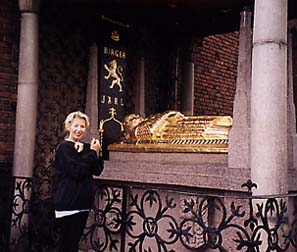
 Tatiana next to the mausoleum of Birger Jarl - the founder of Stockholm in 1252 |
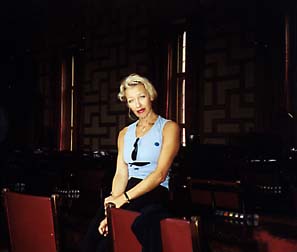 Tatiana in The Blue Room at The City Hall, Stockholm in July, 2000 |
On the Streets of Stockholm
by Tatiana Pahlen
Truly, Sweden is a wonderland.
Since 1901, this enchanting kingdom is the mother country of the Nobel Prize, seeking out the nominees from all over the globe.
In the Blue Room of the City Hall, where those fortunate winners emerge to collect their prizes, you would not find a tiny trace of blue. Seating capacity is no more than 1,300 guests.
The construction of City Hall began in 1911.
I'm warning you, it's almost impossible to fall from the stairs leading to the banquet tables, even for a badly drunken nominee. The main architect, Ragnar Ostberg, while work was in progress, urged his wife Elsa to run up and down the stairs, dressed in her evening gown and high heels, to be sure of everyone's safety. Immediately after they opened in 1923, Elsa ran down the stairs for the last time and for good. Without saying adieu, she left her architect.
My heart was pounding as I climbed these very stairs, that decades earlier, the great writer and poet Ivan Bunin, the first Russian Nobel Prize winner, mounted in 1933. Let me introduce you to the other Russian winners in Literature. In 1965, from the Don River spreading the smell of tractor fumes, the literal larcenist, Mikhail Sholokhov, entered the City Hall. During the Civil War, Sholokhov stole a manuscript from a dead soldier's pocket. He made four books out of it; this instantly became a classic of Soviet Literature. Then he produced thirty more, based on the same stolen goods. Unfortunately, Boris Pasternak was forced to decline his award in 1958. He created a striking and much loved Russian masterpiece,"Doctor Zhivago." For that he was shunned to death by his comrade-writers who suspended his designated writer's membership then cut him off from a literary community.
In 1970, Alexander Solzhenitsyn rightfully earned the prize; he was earlier expelled from the Gulag before being axed and deported from the Soviet Union for his studious and breathtaking Archipelag Gulag. In 1987, the torch went to Joseph Brodsky, who was booted from the Soviet paradise soon after as well.
There was another candidate that declined his prize. A French novelist-philosopher, a self-proclaimed existentialist, Jean-Paul Sartre, a winner in 1964, nobly bowed out of his nomination in protest to the values of bourgeois society. Ironically, Mr. Sartre lived a bourgeois life himself, much like his mentor Karl Marx.
My abysmal thoughts faded as I overheard the tourists' voices buzzing around me. I left the Blue Room hoping to be back one day.
Birger Jarl built Stockholm in 1252. The City sits cozily on the water and attracts the attention of countless immigrants. The endless flow of tourists also helps overrun the City: most of them Japanese and American. They can be easily recognized by their worn sneakers, baseball hats and shorts, all disdained by well-heeled Europeans.
Swedish television widely broadcasts guidance on how to survive the locust-like invasion of foreigners. The simplest way is taking an excursion to one of the archipelagos by using the tourist's boat, where for some rather odd reason, the tourists' sneakers don't gather. They all jumble in the center of the old City, called Gamla Stan. Currently the archipelagoes are becoming the hiding places for the local VIPs.
The biggest crime is jumping ahead of the line, which builds in front of the tiny cafeterias one sees all over the town. It looks like nobody works here; everybody spends their time gulping coffee or beer. Official working hours are from 7 to 4. After four, the idle line doubles at the restaurants.
But 17% of the citizens that didn't join these lines are most likely on the suicide watch, which is a rapidly growing segment in Scandinavia. The highest rate, 28%, stays steadily in Finland. The lack of light in wintertime and the lack of excitement on the streets incite those hopeless folks to take their lives for the sake of the event itself. There is plenty of light in the summer: all night long . . . Really, when you don't need it. One must be totally drunk to tolerate the brilliant sunrays bursting through the double curtains and keeping you awake all night.
I've heard some legends about the good-hearted reigning Queen Silvia. Passing the palace guards, her Majesty often treats the young watchmen with Haagen Dazs and rarely scolds them for the dingy buttons on their blue uniforms.
These days the Swedish Government is plotting to pull three million tax dollars from the working class in order to multiply the frogs. The plan is to design three lakes for the three different types of frogs. That's because the cold-blooded families couldn't dwell together in the same pool. No Frenchman is allowed near these areas! The Government requirement is to keep the frogs' legs attached to their bodies.
Therefore the question was raised, how to feed these rascals? Their usual meal is bloodthirsty mosquitoes and flies, which could not exist without regular donors. Many volunteers with superb blood records are relocating to the special zones to save the vanishing green skinned clan. Swedish researchers are well aware of the lesson with the dinosaur. They're taking this phenomenon of disappearing frogs to a superlative level. Some of them from a magic kiss of Scandinavian femme fatales, would turn into charming princes. Perhaps, this would end the overseas passages with all those Swedish vixens in search for the alien princes, because their local folks, as they're revealing, are icier than stillborn frogs.
They're all welcoming Russians: they love them there. Russian words are heard everywhere, mostly at the shoe stores. Shoes in Stockholm are cheap and durable like the lifestyle of this country. A twenty five percent tax is added on everything, including groceries. Water is pure and directly from the tap is tastier than Evian.
In the Summer the sun is scorching, but don't get fooled. Remember, never venture outside without a sweater. Despite the heat during the daytime hours, it 's chilly after 5 p.m. But if you forgot to bring it along, don't worry, the trendy bars and restaurants will offer you a woolen quilt. You may notice these striped mountains of blankets on every chair.
After a week in Stockholm, I only counted six hobos: quiet, modest, and neatly dressed. No one hits you on the head with a brick, pushes you under the train or begs. People seem to mind their own business: the homeless are drifting around and picking the drained beer cans from the spotless garbage baskets.
The subways are cleaner than American hospitals. You won't view the art of graffiti, won't sniff urine down there.
You don't see the signs: "Curb your dogs." There are no dogs on the streets. Needless to say, when you walk, you don't have to look down. The Swedes drive their canines to the park; they think it's brutal for their loved ones to touch the ground lacking grass.
You don't hear this word stress: it does not exist in their lexicon. And, of course, it doesn't slip from tongues of the visitors arriving to dip their fatiqued bones into this mirthful environment in the Summer.
Truly, Sweden is a wonderland!