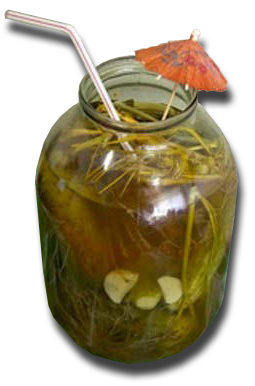
Pickle Juice
by Tatiana Pahlen
On September 20, 1982, I woke up, suffering a nagging hangover in my Moscow apartment. ‘Why was I abusing myself, silly girl? What a waste! Why didn’t I shatter the last glass of vodka and scream — enough is enough for once!’ Curling up in bed, I recalled all those countless toasts and various liquors flooded like a river in my bottomless throat. Through a bleary prism I had a vision of a large studio filled with ancient icons of haunting Christ and St. Nicolas, the Virgin Mary and Baby Jesus, spread out between large canvasses of post-modern Russian art. Birthday celebrations in Russia often went on for days. New guests arrived bringing more booze, pumping up energy with explosive guffawing and vigorous gestures. A mixed group of artists, actors, writers, poets, antiques dealers and dubious characters with a criminal past, showed up to honor a self-taught icon restoration figure and the recent cause of my drinking spree.
Feeling parched, like a fallen leaf, I was hankering for pickle juice or cabbage rassol, which is basically vegetable brine, a secret remedy among Slavs to cure hangovers. The best quality was up for grabs at the Tishinsky bazaar where I had a flat for a while. There were times when I indulged myself in the early morning, shuffling to the same stand and looking for this sweet, little babushka with rosy cheeks in a white apron. She was toothless and shaped like the barrel where she kept her pickled goods. She knew her craft well enough to lure me back. I carried my own mug. “Feeling better?” as she filled my cup over the top and watched it vanish in one breath. “Like a pickle!” My voice rustled. She winked at me, shining like a Tulsky Pryanic (honeyed biscuit baked in Tula, an oblast in Russia,120 miles south of Moscow on the Upa River.) The soulful babushka was more than happy to offer a second helping. My stomach growled with appreciation. ‘Shall I pay her a visit?’ I deliberated, ‘but what if the granny is no longer there?’ It’s an intricate drive, and the traffic circling through the center of Moscow was especially bad! I settled on Plan B, the Hungarian pickles at the local grocery store.
My humble dog, Timoshka, a black toy poodle, came over with his tail wagging, carrying plush slippers in his jaws. Looking concerned, he placed his head on my blanket and exhaled a big sigh. ‘I’ll be alright,’ I assured him, thinking only of calming my palate. I scratched his ears and he licked my fingers. If he could, he would fetch my medicine, dashing down fourteen stairs to a grocery store coming right back in no time with a jar of pickles. But alas, he was just a dog, whose limit went as far as to witness my wildest libation intemperance. Timoshka mingled equally well with all sorts of crowds and traveled with me in wherever direction the wind moved us. He never whined. He was quick on his foot and had a tooth for adventures. He was also a pivotal partner, charming traffic cops in times I was stopped pointlessly for violations. Timoshka could talk our way out and spare me the trouble of dealing with the toughest cops. He was a gifted “con dog” and high-end negotiator.
During the Brezhnev era, luxury services such as ordering delivery from a store were unthinkable. It was considered exploitation of labor, a failing of capitalism. I wonder if Putin fixed that.
The lines in the supermarkets were endless. You have to pay on the spot at each counter. The same person who sliced and diced handled the cash. There were no credit cards introduced to civilians. The meat department where Timoshka gets his filet mignon was separate from the cheese, and so was the line for the fish cutlets, where I stood sporadically to spoil stray cats that came along to play in my backyard. Cottage cheese, herring, kielbasas, caviar, (red and black) and other produce also had their separate departments and longer lines. The tired looking workhorses perpetually sliced the assorted edibles before weighing and wrapping it hurriedly, avoiding eye contact with hostile customers, who in return glared at them with eyes full of hatred, standing neck to neck and nudging each other using their elbows to tighten the queue. There were no smiles exchanged or ‘thank you’ in their expression. When the money was counted, these hurried customers cursed and muttered at the labor, and pushed their way closer and closer to the counter. The workers served food without gloves. No wonder rubles smelled like herring. I knew a number of individuals that shampooed and ironed their kapusta (cabbage) a Russian term for money, making seedy-looking bills crisp again.
I reached for my slippers. Timoshka supervised me in getting up and watched as I gulped warm, chlorine-infused water, streaming from the kitchen faucet. He knew I was out of Borjomi, (a Georgian mineral water famous for curative power in the Caucasus, similar to San Pellegrino, the product of Lombardy a region known in Italy where the first moneylenders originated). He followed me to the closet where I quickly pulled out my street clothes; his leash was already in his mouth. A nearby supermarket was a two-minute walk through a tiny park that surrounded my building, and was located on the Leninsky Prospect, across the street from Gorky Park, a wide road leading to the airport. I looked at the window and saw my car parked diagonally, taking two parking spaces. ‘Good Lord! I better move it quickly, before a deranged comrade kicks my door in and breaks my kneecaps.’
The autumn air smelled sweet. Leaves hadn’t turned yet, but you can already discern these small dots of bright yellow, auburn and red, forming on its corners, which brought a bit of melancholy and sentimental anxiety to affectionate souls… with no watch on my wrist I could only guess, (according to the sun positioning), it was somewhere around 10 am, but I couldn’t swear to it. I wobbled to the car, opened the door, and let Timoshka take his spot.
The fact that I could see my grocery store through the trees was comforting, but when driving, I needed another fifteen minutes plus, depending on the traffic. One had to drive in the opposite direction and make various twists and turns with four traffic lights ahead, before ending up on the Leninsky Prospect. From there one needs to make a U-turn at the longest traffic light to park next to the store. Once I saw a trick by a taxi driver whom I followed. He knew a short cut, going through the curb ending on the main road in less than a minute without a hassle.
My co-op was built in a peculiar way — far from the road. Designed for the Russian scientists, it provided some sort of privacy. Two academics lived on the floors below; my next-door neighbor, a ninety-year old engineer, Vladimir Malachov, was the inventor of fake caviar made from crude oil, for which he was rewarded a Lenin’s medal and 25 years of prison in Stalin’s era. At ninety he was still able to multiply four digits without a calculator, and was married to a younger woman half his age. He was very charming and often encouraged me to challenge his counting talent over and over during our tea chat. The former inmate made it strong with extra care and ceremonial that included a pinch of salt in the teapot that allegedly brought a sweeping aroma, before he meticulously poured out his obscure liquid into the finest china. I perceived how much I miss this scent…Another neighbor, Boris, a sixty something years old doctor, invented a homemade version of a radiation detector device. After the Chernobyl disaster on April 26, 1986, most fresh produce sold in bazaars came from Ukraine and Byelorussia and was tainted with high levels of radiation. Boris knew which food stand was safe and which to avoid. He was more than happy to share it with me till the day I departed from Russia a few months later, finding a benevolent harbor in the United States.
I saw his radiation device jump wildly reacting on my jacket. When the explosion occurred I was in Sochi, a posh Black Sea resort, in the southern region of Krasnodar, and now a new lucky winner to host the Winter Olympics Games in 2014. The accident was withheld from the public for a week. My companion Marina and I ate toxic fruits and berries, paid good money for the baby carrots pulled from the garden, as well as freshly picked salad leaves, tomatoes, radishes and other veggies we could afford at the near fresh market. It was all tainted! No one knew, of course; we were fasting for Easter. I must admit I dragged her into this Russian Orthodox routine — all new to her. (Against all odds, Marina, years later, ended up marrying a friend of mine, a conductor Maxim Shostakovich, the son of the Russian composer, Dmitri Shostakovich. I casually introduced the lovebirds. After bearing him two children and moving to St. Petersburg, they built a church where she is now a principal, schooling pupils in the New Testament! I should be charged for planting the high-yielding seeds…) On Easter night, May 3rd we got drenched in the rain attending a five-hour service at a cramped local church. No one had umbrellas, and the chapel was packed tighter than sardines. The downpour was contaminated with radioactive material for two days. I had severe tremors at night for a week, and not knowing the actual reason, blamed my masseuse whom I paid a few visits. Aftermath, I developed a thyroid problem due to the Chernobyl disaster. As was reported later, most European countries got hit with the toxic rainfall that reached as far as Ireland (as if they don’t have their own toxicity in the local pubs!)
Thinking of toxins added to my body for the past two nights, and still longing for a cure, I steered my wheels up onto the curb and drove through the hidden path. Within seconds my frisky Lada, a Russian version of Fiat, was parked neatly at the store’s door.
All canned and bottled produce were the fastest to check out; the prices were already labeled. I purchased the heavenly jar of curative and went to the next line to buy my dog’s daily ration. By now he had repositioned himself on the driver’s seat and was eyeing me through the window.
I smiled and blew him kisses. He wiggled with anticipation. Suddenly, I saw a few cops rushing towards my car. Timoshka, sensing trouble, slipped from the driver’s seat down and turned into a floor carpet.
‘Good move,’ I sneered. ‘Why are they hovering there? The parking was legal. No one saw me maneuvering a short cut.’ From time to time the KGB had tailed me, but I had no problem to detect them tagging behind. I even stopped my car once and went straight to them, offering to ride together. “Why should I burn my gasoline if we have the same destination?”’ I demanded. They showed me off and dispersed for a while, but this new scene was more dramatic and much too obvious. I paid for meat, but was reluctant to go outside. Instead, I choose another line where I could slice a pound of cheese and watch the cops, stargazing at my car. Shortly, looking back, I counted more men; some of them appeared in military uniforms madly pacing around my vehicle. I was getting astonished; they were multiplying. I saw Sergeants, Captains, Majors, Lieutenants and a General going in and out of the store to get another peek at my car. ‘What’s going on?’ I paid for the cheese and lined up for salami.
By the time the clerk finished slicing, I saw the whole squad arrived with the sniffing dogs, which jumped high making their handlers work hard. Finding no explosives, the hounds humped my car and barked franticly. ‘Poor Timoshka!’ I could settle with the dogs giving away my salami, but what about others? Why today when I’m stuck with a hangover?’ I opened my jar and took a big sip. ‘Uhhhh.’ A middle-aged clerk counted the change and raised her eyebrows. I took a larger gulp. “Pickles anyone?” I was getting bold. ‘What if I ran over a body last night?’ I strained my brain trying to remember how did I get home. Grim images grew in my mind. ‘What if my car plates connect to a murder?’ The site of a military helicopter made me choke on the pickle. ‘There is no way out of this mess, unless I sneak out the door and run, but where? And what about Timoshka? He would be soon found and taken a hostage. Of course, he won’t say a word even if they water-board him. And what about these pack of wolves! They would eat him alive! Leave my partner behind? Never!’
With one hand full of groceries and another fortified with pickles I made the first move approaching a handsome general with deep, sad eyes and a lonely dimple on his clean-shaven cheeks.
“Officer!” I called out, “You can now precede to arrest me!”
“Arrest you? He looked puzzled. “Why?”
“On the record, I’m surrendering on my own terms!” I raised my hands up balancing groceries like dumbbells.
“On what counts?”
“I don’t know, you tell me, Sir!”
“What makes you think I’m to arrest you?”
“I was watching you.”
“Watching me?”
“Yes, Sir!”
“Why?”
“You were interested in my car.”
“Is it your car outside?”
“Yes, Sir!”
“Aha!”
“What’s wrong with my car?”
“How did you get here?”
“I drove.”
“From where?”
I pointed at my building popping through the park.
“All roads are closed. There are no cars on the streets from 8 am till 5 pm; how the hell did you get here?”
“Why?”
“Don’t you read the newspapers or watch TV?”
“Sorry, officer, I was out of town.” I lied.
“Indira Gandhi is arriving!” He scolded me.
“That’s exciting!” I screamed earnestly.
“Driver license and registration please!” He frowned.
“It’s in the glove compartment!” (I kept my valuables there, making life easier for the thieves.)
“Can you move your car as fast as you can?” He adjusted his peaked cap, scratching his head vigorously.
“Right away! When she is passing through this zone?”
“Any moment! The Prime Minister has already landed in Sheremteyevo. Move!”
The prospect was desolate, except for my car, which stuck out like a sore thumb.
“Hurry up!” He radioed the cops ordering their dogs away from my car.
“Yes, officer!” I marched towards the exit, “and thank you, Sir!”
“I should thank you too,” he said with slight hesitation. It was a brave act on your part to come forward, comrade! You saved us from unnecessary headaches.”
“Oh, don’t mention it, comrade general.” I blushed.
I opened my car seeing Timoshka still hiding on the floor. “Come on, buddy, we are clear,” I said. “Put your furry butt back on your seat. You just missed a tremendous spectacle while playing a rug. One day I will tell you," I smiled.
I opted not taking a hidden path going back home. For that I was magnanimously rewarded. What happened next one could only see in the movies. Suddenly the Leninsky Prospect was swarming with Soviet people. The whole working class filled the streets; every side and corner was packed with thousands and thousands of them. The children sat on the top of their parents shoulders, swinging colorful balloons; women gathered with bright flowers, craning their heads impatiently, men displayed overused, trite banners and held high the Russian and Indian flags that swayed smoothly in the light wind.
I moved at a snail’s pace, enjoying every second of my fifteen minutes of glory. The relationship between Russia and India was stabilized. I didn’t have to worry about crazed snipers aiming at my forehead. I fluffed my hair and straightened my posture, putting on “Jacky O” sunglasses, stored conveniently in the glove compartment. The mob roared. With broad smile I waved fiercely, sticking my head out. ‘What if I stop the car and shake their hands? One by one, each individually?’ They all waived back and beamed from ear to ear throwing the flowers on the road. ‘Thank you, comrades!’ I yelled from an open window. “Thank you for coming!” They clapped ecstatically, chanting in unison: “In-di-ra, In-di-ra!” My long blond hair was not an issue. The mob wouldn’t budge even if I powdered my head with the curry, the only spice that makes me puke. For once I saw countless gregarious faces cheering unconditionally. I couldn’t get enough of it. Minutes ago I was a “convict;” next I became a national hero. I felt their love overflowed the sky in the shape of a flock of white doves set free for a historic occasion. Timoshka perked up his head and shared my happiness. As I made a U-turn, a motorcade led by roaring motorcycles cleared Indira Gandhi’s passage. “There she comes,” I looked impishly at my dog. His eyes twinkled. “Do you think the crowd has dissipated by now? Their mission had been accomplished! How long could one clap do you think?” I felt no shame seizing the moment! The comrades were duped into a devious act once again, since the infamous imposter, Anastasia, crossed the road. I cared less. My hangover was gone!
Copyright © 2010 Tatianyc. All Rights Reserved.